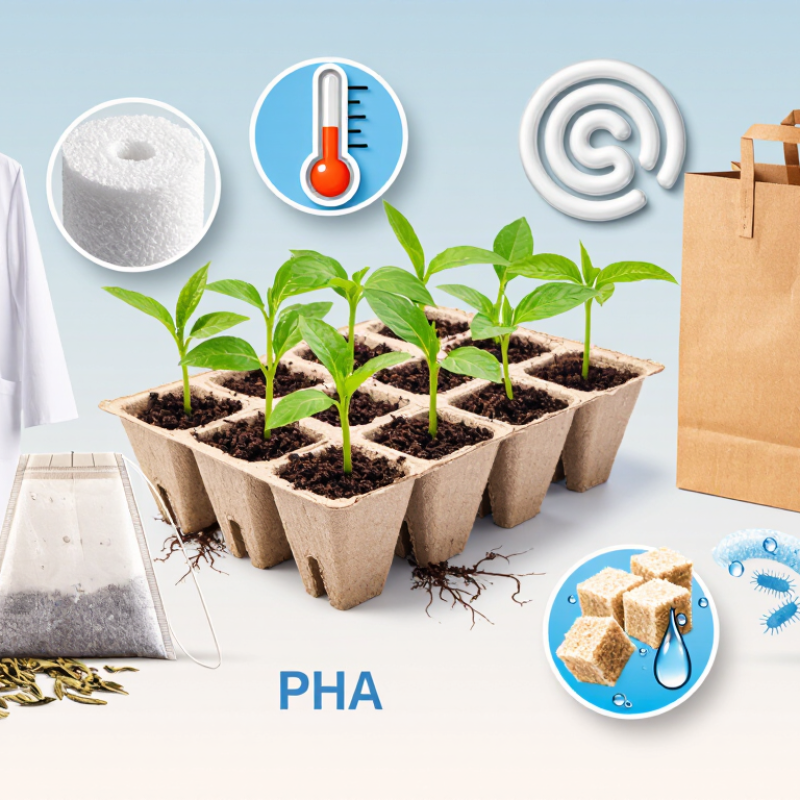
The 2026 search for the best Biodegradable Non Woven Fabric begins with a practical question: what should biodegrade, and where? A hospital gown, tea bag, seedling mat, and shopping bag face different moisture, strength, and disposal conditions. One material cannot serve every use.
Industry data shows why this topic matters. Textile Exchange’s Materials Market Report 2024 recorded global fiber production at approximately 124 million tonnes in 2023. It projects production could reach 160 million tonnes by 2030. European Bioplastics reported global bioplastics production capacity of about 2.47 million tonnes in 2024, with further growth expected by 2029. These figures indicate momentum, not automatic sustainability. A biodegradable product may still require controlled industrial composting, suitable humidity, and sufficient microbial activity.
The details matter. A cellulose-based spunlace can feel soft against skin. PLA fibers can provide cleaner structure and useful heat resistance. Starch blends may degrade faster, but often sacrifice wet strength. PHA offers promising biodegradation potential, although cost and supply remain concerns. Dr. Seshadri Ramkumar, a professor and recognized nonwovens specialist at Texas Tech University, has stated, “Nonwovens are everywhere.” His observation captures the sector’s reach, from wipes to filtration media. Still, “biodegradable” should never be accepted without test conditions, certification, and end-of-life evidence. This guide compares leading fabric types through performance, processing, environmental claims, and realistic disposal pathways. Some conclusions remain provisional. Better data is still needed.
2026 Best Biodegradable Non Woven Fabric Types?
Biodegradable non woven fabric is not defined by a “natural” label alone. Under EN 13432, materials must achieve at least 90% biodegradation within six months under controlled industrial composting conditions. They must also disintegrate within 12 weeks. This is a laboratory benchmark, not proof of breakdown in soil, seawater, or a home compost bin. That difference matters.
Common candidates include cellulose-based nonwovens, starch-blended sheets, and certain certified bio-based polymer fibers. Cellulose can feel like dry paper and absorb moisture quickly. Starch blends may soften faster, but their strength can fall after repeated exposure to humidity. Bio-based polymers can provide better softness and tensile performance, yet they may require precise heat and moisture conditions in a commercial composting facility. Real testing is essential.
Textile Exchange’s Materials Market Report 2024 estimated global fiber production at about 124 million tonnes in 2023, showing the scale of material demand. European Bioplastics reported global bioplastics production capacity of approximately 2.47 million tonnes in 2024, with further growth projected through 2029. These figures suggest opportunity, but not automatic sustainability. A fabric may pass biodegradation testing while its dye, adhesive, or coating fails the same pathway. Product developers should test the complete structure, not only the base fiber. That step is often missed.
2026 Best Biodegradable Non Woven Fabric Types?
PLA, cellulose, PHA, and chitosan nonwovens are competing for different jobs. PLA offers stable web formation, soft handling, and industrial composting potential. However, it may fail in ordinary soil. Cellulose fibers absorb moisture quickly and suit wipes, medical pads, and packaging layers. Their performance depends heavily on coatings, binders, and farming practices.
PHA is more interesting for environments where biodegradation matters beyond controlled composting. Yet, production remains less mature and usually costs more. European Bioplastics reported global bioplastics production capacity at about 2.47 million tonnes in 2024. Its forecast reaches roughly 5.73 million tonnes by 2029. This figure covers bioplastics broadly, not nonwovens alone. That distinction matters.
Chitosan provides natural antimicrobial potential and strong film-forming behavior. It can improve surface functionality, but moisture sensitivity and feedstock consistency remain practical concerns. The OECD reported that only 9% of global plastic waste was recycled in 2019. That statistic strengthens interest in biodegradable fibers, but biodegradability is not automatic disposal permission. Composting temperature, humidity, thickness, and additives can change results. In factory trials, I would test tensile strength after wet storage, not only dry samples. PLA may lead high-volume applications in 2026. Cellulose may lead everyday absorbent products. PHA could lead specialized compostable structures. Chitosan remains promising, though its commercial scale is still uneven. My ranking is imperfect because “best” depends on the end-use, disposal route, and required service life.
For 2026, biodegradable nonwoven fabric selection depends on basis weight, tensile strength, and moisture exposure. European Bioplastics’ 2024 market data projects global bioplastics capacity to rise from about 2.47 million tonnes in 2024 to 5.73 million tonnes by 2029. PLA, cellulose, and PBS-based nonwovens are gaining attention. However, “biodegradable” does not always mean home-compostable. Testing conditions matter.
At 20–40 GSM, PLA and cellulose webs feel light and breathable.
They suit dry wipes, tea bags, and protective wrapping, but their tear resistance remains limited. Around 60–100 GSM, hydroentangled cellulose or PLA blends offer better handling strength. In practical testing, tensile performance can change sharply with fiber orientation and bonding method. A fabric may feel strong lengthwise, then split across the web.
At 120–200 GSM, needle-punched PLA or blended structures provide stronger cushioning and filtration support. Moisture resistance becomes the difficult trade-off. Cellulose absorbs water quickly, while PLA generally maintains shape longer in humid conditions. Yet water-repellent finishes may slow biodegradation. ISO 9073 test methods are useful for comparing tensile strength, elongation, and basis weight, but results are not directly comparable across different procedures. Smithers’ recent nonwovens outlook also highlights sustainability claims as increasingly dependent on verified end-of-life testing.
Performance is never just a GSM number. A lower-weight fabric may work better when airflow, softness, and controlled moisture matter more than peak strength.
Biodegradable non-woven fabrics are becoming more practical in 2026, especially where lightweight protection meets disposal concerns. Common choices include polylactic acid, cellulose, and blended plant-fiber materials. Each type behaves differently under heat, moisture, pressure, and composting conditions.
In hygiene products, soft cellulose-based non-wovens can support wipes, absorbent layers, and personal-care liners. They feel comfortable against skin and may reduce persistent plastic waste. However, softness alone is not enough. Wet strength, microbial control, and skin safety still require careful testing. Some “biodegradable” fabrics need industrial composting, not a household bin.
Medical use demands stricter judgment. Biodegradable materials may suit gowns, drapes, shoe covers, and selected disposable accessories. Their barrier performance must resist fluids without causing excessive heat buildup. In field experience, a fabric can biodegrade well yet fail during handling. That trade-off deserves attention. Sterility, fiber shedding, and storage stability remain essential evaluation points.
Agriculture uses these fabrics for crop covers, seedling bags, erosion-control layers, and weed-suppressing mulch. Cellulose and PLA options can help reduce manual removal after harvest, although soil temperature and moisture change degradation speed. Packaging applications include produce wraps, protective sheets, mailer inserts, and lightweight pouches. They can cushion products effectively. Still, poor humidity resistance may weaken the package before delivery. Buyers should request compostability evidence, fiber composition, testing conditions, and disposal guidance before selecting a material.
This chart shows application areas in which each biodegradable nonwoven fiber type is commonly reported or technically suitable. A value of 1 indicates a typical application area; 0 indicates that the material is not normally selected for that category. The chart compares application coverage, not market share or sales volume.
PLA is widely used in spunbond, meltblown, and needle-punched nonwovens for hygiene, medical products, crop protection, and packaging. Cellulose-based fibers are common in wipes, wound-care products, filtration, agricultural mats, and protective packaging. Cotton is mainly used for hygiene and medical nonwovens, while jute is particularly suitable for agricultural erosion-control fabrics and packaging.
The best biodegradable nonwoven fabric in 2026 is not defined by a soft feel alone. Buyers should examine the finished fabric, its fibers, binders, coatings, and packaging together. A certificate for one resin cannot validate the entire product.
Request complete laboratory reports, not only certificate numbers. Check whether testing followed EN 13432 or ASTM D6400. EN 13432 focuses on industrially compostable packaging, including disintegration, biodegradation, ecotoxicity, and heavy metals. ASTM D6400 evaluates plastic items designed for municipal and commercial composting. These standards are related, but they are not interchangeable. Confirm the tested sample matches the production fabric, thickness, color, and additives. Lot numbers matter. So do test dates. Reports from competent laboratories, preferably accredited to ISO/IEC 17025, provide stronger evidence.
Look closely at the LCA. Ask for the functional unit, system boundary, energy sources, transport distance, and end-of-life assumptions. A fabric may show lower production emissions but perform poorly if it requires long-distance composting. Local facilities may also reject certified materials. That detail is often missed. In my purchasing reviews, I would compare the report with a physical sample and supplier traceability records. Claims can still be incomplete. Composting conditions vary widely, and laboratory results cannot promise backyard decomposition. A cautious buyer should record these uncertainties before approving a material.
| Material family | Typical nonwoven format | Feedstock and composition | What the material name can and cannot prove | EN 13432 relevance | ASTM D6400 relevance | LCA information buyers should request | Recommended verification checks |
|---|---|---|---|---|---|---|---|
| PLA-based nonwoven | Spunbond, meltblown, needle-punched, or composite structures | Polylactic acid, commonly produced from fermented plant-derived sugars; additives, coatings, binders, or reinforcing fibers may be present | PLA content alone does not prove that the finished fabric is compostable. Colorants, finishes, laminates, and blended fibers can change the result. | Potentially suitable for industrial compostability assessment when the complete finished article meets disintegration, biodegradation, ecotoxicity, and heavy-metal requirements under EN 13432. | Potentially suitable for ASTM D6400 evaluation when the complete product, including additives and coatings, meets the standard’s industrial composting requirements. | Functional unit, resin and additive inputs, agricultural inputs, energy mix, fabric weight, production yield, transport, packaging, and end-of-life scenario. Check whether biogenic carbon is reported consistently. | Request a certificate or test report for the exact fabric construction; verify product thickness, basis weight, color, coatings, and blend ratio against the tested sample. |
| PHA-based nonwoven | Melt-processed webs, spunbond structures, and blends | Polyhydroxyalkanoates produced by microbial fermentation; grade and formulation strongly affect processing and degradation behavior | “Bio-based” and “biodegradable” are separate claims. A PHA grade should not be assumed to pass a specific compostability standard without testing. | Can be evaluated against EN 13432 as a finished product. The standard does not approve a polymer family automatically. | Can be evaluated against ASTM D6400 for industrial composting; the test evidence must cover the actual finished construction. | Feedstock and fermentation energy, nutrient inputs, solvent or chemical use, drying energy, yield, allocation method, and treatment of production residues. | Check independent laboratory results for biodegradation and disintegration, plus ecotoxicity and regulated-metal data where applicable. |
| Cellulose or wood-pulp nonwoven | Airlaid, wetlaid, spunlace, tissue-like, or cellulose-fiber composites | Regenerated cellulose, wood pulp, or other cellulose fibers; may include wet-strength resins, binders, dyes, or synthetic reinforcement | Uncoated cellulose is generally biodegradable, but the finished fabric may not meet compostability requirements if it contains persistent binders, synthetic fibers, or unsuitable finishes. | The finished article must satisfy EN 13432 criteria; cellulose origin alone is not certification evidence. | The finished article may be tested under ASTM D6400 if it is intended for industrial composting and contains no disqualifying components. | Forest-management or agricultural sourcing, pulping or regeneration chemicals, water and energy use, wastewater treatment, transport, and land-use assumptions. | Request fiber composition, binder and finish disclosure, pulp sourcing evidence, and a test report using the same basis weight and construction. |
| Viscose or lyocell nonwoven | Spunlace, wetlaid, or hydroentangled fabrics | Regenerated cellulose made from dissolving pulp; processing route and chemical recovery system influence environmental performance | Regenerated cellulose is not automatically compostable as a finished product. Durable finishes, elastic components, and synthetic support layers require separate assessment. | Applicable only to the complete finished product and its components; an EN 13432 claim should identify the certified or tested article. | Applicable for industrial-compostability evaluation when the full product meets ASTM D6400 requirements. | Dissolving-pulp source, chemical recovery, electricity and heat, water consumption, wastewater, production scrap, and the declared end-of-life route. | Ask whether the claim applies to the fabric alone or to a finished product containing adhesives, elastic, printing ink, or packaging components. |
| Cotton or other natural-fiber nonwoven | Needle-punched, thermal-bonded, hydroentangled, or felted webs | Plant or animal fibers; may contain binders, dyes, flame retardants, antimicrobial treatments, or synthetic support fibers | Natural origin does not establish low environmental impact or compliance with compostability standards. Agricultural impacts and chemical treatments must be considered. | A clean, untreated fiber web may be assessed, but dyes, finishes, and binders can affect disintegration, biodegradation, and ecotoxicity results. | The same finished-product principle applies: ASTM D6400 does not grant automatic approval based on natural-fiber content. | Irrigation, fertilizer and pesticide use, land occupation, yield, fiber preparation, spinning or web formation, energy, and land-use-change assumptions. | Verify fiber percentage, chemical treatment list, recycled or virgin content, agricultural data source, and the declared composting conditions. |
| PBS or aliphatic-polyester blend | Spunbond, meltblown, coating-supported, or blended nonwovens | Polybutylene succinate or related aliphatic polyester; may be blended with PLA, starch, cellulose, or conventional polymers | The polymer family and blend ratio affect compostability. A conventional polymer fraction can prevent the finished product from meeting a compostability claim. | Requires testing of the exact formulation and article under EN 13432; industrial compostability should not be inferred from “degradable” wording. | Requires testing of the exact formulation and article under ASTM D6400, including additives and nonwoven processing aids. | Monomer origin, bio-based share, catalyst and additive inputs, polymerization energy, yield, electricity mix, and treatment of process emissions. | Obtain a full bill of materials and confirm that the laboratory sample matches the production version in resin, basis weight, color, coating, and lamination. |
| Starch-based or starch-blended nonwoven | Film-supported webs, airlaid structures, molded fiber composites, or blended fabrics | Thermoplastic starch or starch blended with biodegradable polymers, cellulose fibers, plasticizers, and processing additives | Starch may biodegrade readily, but the complete product can leave persistent fractions or fail physical-disintegration requirements if blended or coated. | Must demonstrate the EN 13432 requirements for the complete article, not merely starch biodegradation in isolation. | Must demonstrate ASTM D6400 requirements for the complete article and its relevant components. | Crop yield, fertilizer and irrigation, starch extraction, plasticizer and polymer inputs, processing energy, water use, and food-versus-material allocation assumptions. | Request formulation disclosure, residual synthetic-polymer content, moisture and storage data, and independent test evidence for the finished fabric. |
Leave your projects details, and one of our team will reach out to answer any questions you may have